As youth players get older, coaching naturally changes. There is always something fun about watching a group of five- and six-year-olds chase a baseball around the field, but there are limits to what you can realistically expect them to do. At those young ages, and for several years after, coaches focus almost exclusively on the fundamentals.
We teach players how to run the bases, throw, catch, and hit. We teach the basics.
As players develop, we can introduce more advanced concepts—situational baseball, defensive alignments, pitch sequencing, game strategy, and countless other nuances of the game. In many ways, these advanced concepts make coaching more interesting and rewarding. However, none of them can be taught or mastered without first understanding the fundamentals.
Visit a baseball or softball practice for players between the ages of seven and ten, and you’ll hear coaches constantly reminding players to “have a good catch” and “hit your partner in the chest.” Now watch a high school practice. Often, you’ll see coaches chatting among themselves while players warm up.
Not the best coaches.
The best coaches are still paying attention to the quality of the catch their players are having. They are still reinforcing proper throwing mechanics. They are still focused on the fundamentals.
Why?
Because great coaches understand that when fundamentals begin to slip, bigger problems are usually right behind them. When players stop making routine plays, executing basic skills, and paying attention to details, games are eventually lost—not because of advanced strategy, but because of neglected fundamentals.
The same principle applies to leadership.
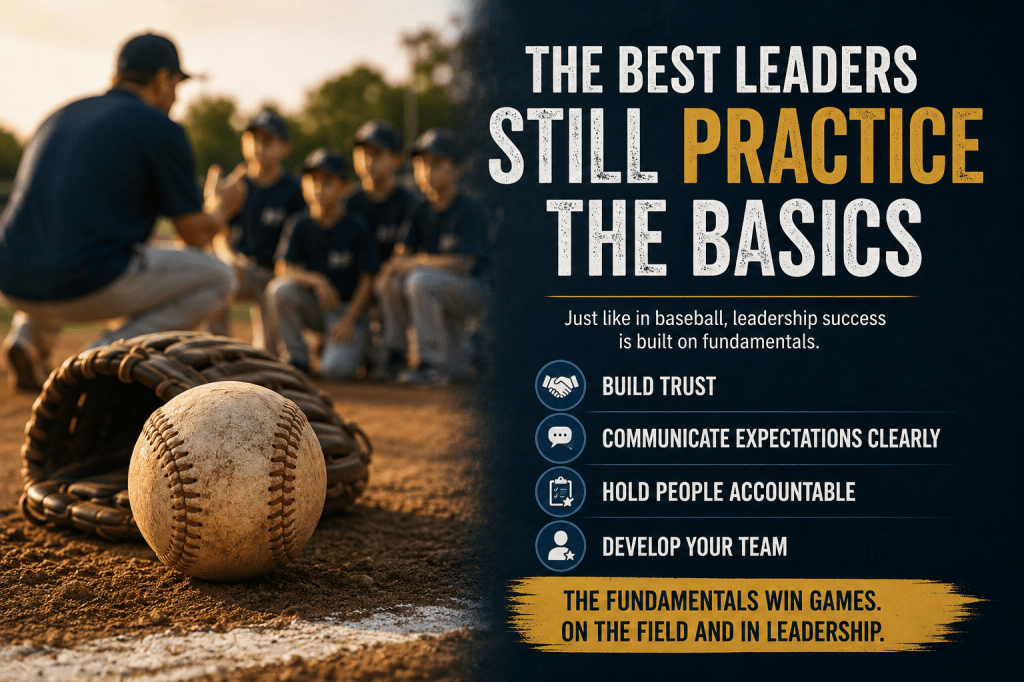
The challenge, of course, is determining what leadership fundamentals actually are. Some may vary based on the organization, industry, or situation. However, I believe there are four leadership fundamentals that matter regardless of circumstances:
Build trust
Communicate expectations clearly
Hold people accountable
Develop your team
These are the leadership equivalents of throwing, catching, and hitting.
Too often, leaders become consumed with business results, financial metrics, strategic initiatives, and quarterly targets. While those outcomes matter, they are ultimately the result of leaders consistently executing the fundamentals.
When leaders fail to build trust, communication breaks down. When expectations are unclear, performance suffers. When accountability disappears, standards decline. When employees are not developed, growth stalls.
ust as championship teams are built on a foundation of fundamental skills, successful organizations are built on a foundation of fundamental leadership behaviors.
The best leaders, like the best coaches, never outgrow the basics. They understand that fundamentals are not something you master once and move beyond. They are something you practice every day.
Because in leadership, just as in baseball, the fundamentals win games.


Leave a Reply