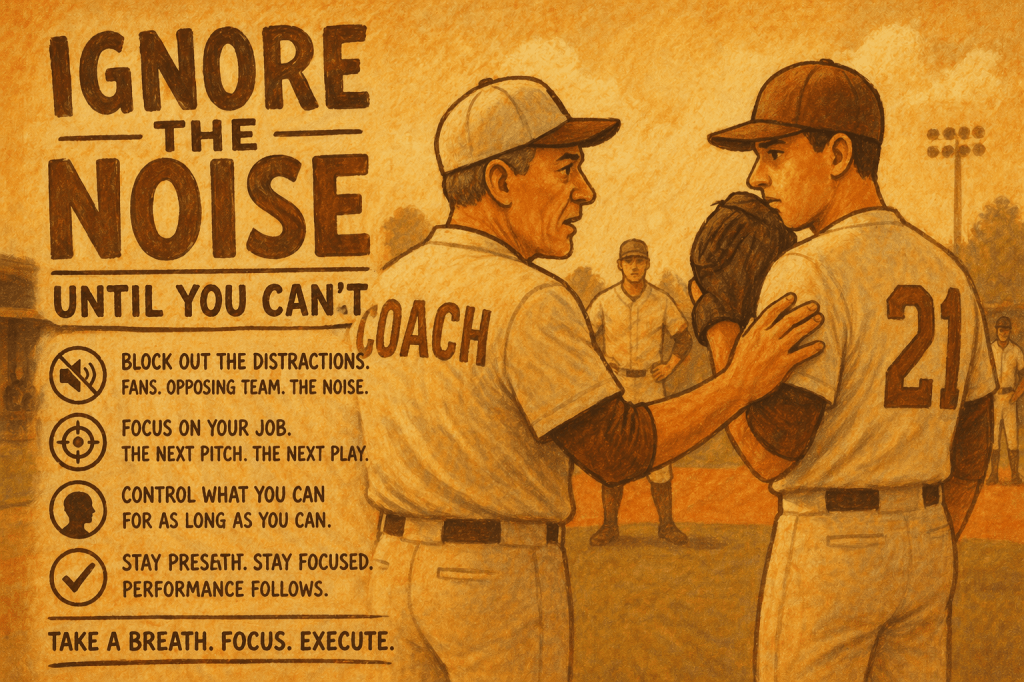
During any given game, it’s very likely that one of the few things you’ll hear me yell at a player is, “Take a breath and focus.” What I’m trying to remind them to do is simple—but not easy: block out all the outside noise—fan chatter, the opposing bench, runners on base—and lock in on the task at hand. Whether they’re in the batter’s box, on the mound, or in the field, I want players to focus on their specific job. Ignore everything else…until you can’t.
In both youth and high school baseball and softball in my area, opposing dugouts can be very “chirpy.” Teams try to rattle each other by being loud—and sometimes, if we’re being honest, crossing the line. If you walk a batter, make an error, or strike out, you’re going to hear about it. That’s part of the environment. It’s not always right, but it is reality. And the players who learn to handle it best are the ones who gain a real competitive edge.
The key isn’t pretending the noise doesn’t exist. The key is choosing not to engage with it.
Great players develop the ability to narrow their focus. A hitter steps into the box and doesn’t think about the last at-bat, the score, or what the other team is yelling. They focus on one thing: the next pitch. A pitcher who just walked a batter doesn’t spiral. They take a breath, reset, and execute the next pitch. An infielder who just made an error doesn’t carry it into the next play—they get ready for the next ball hit their way.
That’s what “ignore the noise until you can’t” really means. You control what you can control for as long as you can. But there are moments in a game where you do have to acknowledge reality—the runner stealing, the bunt situation, the game speeding up. At that point, awareness matters. But even then, it’s focused awareness, not emotional reaction.
This lesson goes far beyond the field.
In leadership, the “noise” just looks different. It might be office politics, outside opinions, second-guessing, or pressure from multiple directions. Leaders are constantly surrounded by distractions that can pull them away from what actually matters. The best leaders, like the best players, learn to filter it out. They stay grounded in their role, their priorities, and the decision in front of them.
They don’t ignore everything forever—but they ignore it long enough to stay effective. Because performance—whether on the field or in the workplace—comes down to focus. The ability to slow things down, take a breath, and lock in on what matters most in that moment.
So the next time things start to speed up, or the noise gets loud, remember the simplest coaching cue there is:
Take a breath. Focus. And ignore the noise—until you can’t.


Leave a Reply