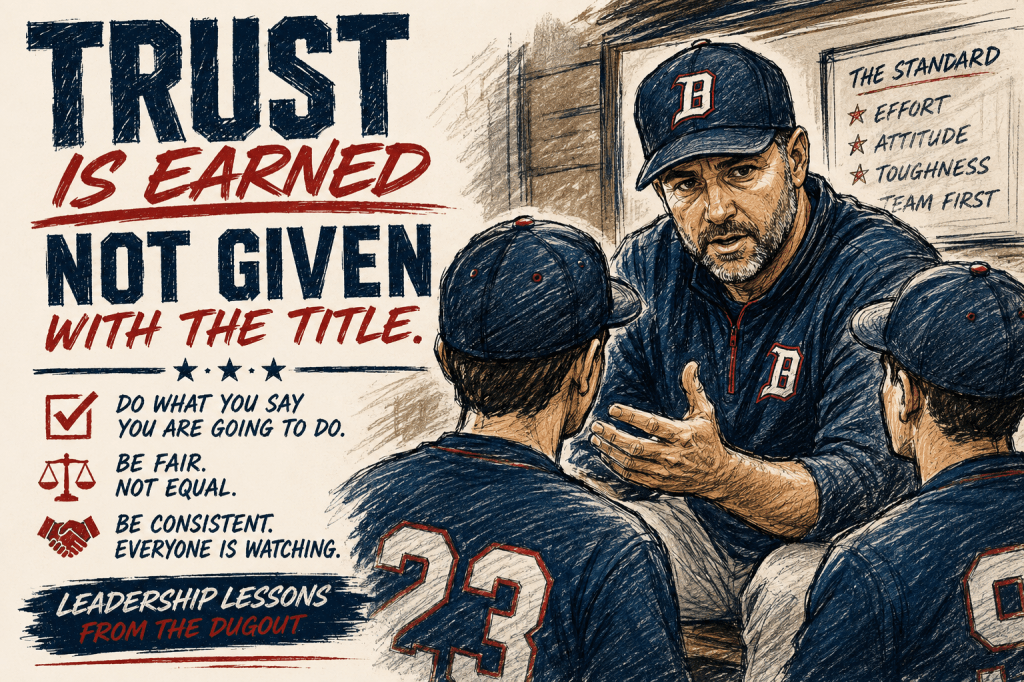
One of the biggest mistakes we make as coaches, leaders, and managers is assuming trust automatically comes with the title. Too often, coaches believe young players will trust them simply because they are the “expert” or the adult in the room. The reality is, trust does not come with a whistle, a lineup card, or a job title. Trust is earned through consistency, fairness, and follow-through over time.
If we want to build trust with players, parents, employees, or coworkers, we have to provide a consistent approach and, most importantly, do what we say we are going to do.
In baseball and softball, players notice everything. If I tell a player he is going to play a certain position and then I change my mind without explanation, I might get away with that once. Maybe even twice. But eventually, that player stops believing me. Once that trust starts to disappear, everything becomes harder. Communication suffers. Buy-in disappears. Effort declines. The player may still show up physically, but mentally they begin checking out.
The same thing applies to the little promises we make to a team. If I tell players we are going to work on baserunning every day, but we continually skip it, eventually the team starts questioning my integrity. Players begin wondering if anything I say actually matters. Trust is not built through speeches. It is built through repeated actions that align with your words.
Building trust also goes beyond simply following through. It applies to how consistently and fairly we treat people.
Fair does not always mean equal.
One of the most important lessons young coaches and leaders must learn is that every situation is different, but the standards must remain consistent. If the team rule is that players run out every ground ball or the team runs sprints afterward, then that standard has to apply to both your star player and your number nine hitter. The moment players believe the best athlete gets treated differently simply because they are talented, trust starts to erode across the entire team.
At the same time, fairness also requires leadership judgment. If a player fouls a ball off his foot and cannot run full speed safely, that situation deserves context. Consistency is not about robotic leadership. It is about applying standards honestly while still recognizing circumstances.
The same principle applies in the workplace. Employees quickly recognize inconsistency. If leaders allow one employee to ignore deadlines, skip meetings, or avoid accountability while holding everyone else to a different standard, trust within the team begins to collapse. People may not always say it out loud, but they notice.
In both sports and leadership, trust is built in small moments long before it is tested in big ones. Consistency earns credibility. Credibility earns trust. And trust is what ultimately gives leaders the ability to influence, develop, and lead others effectively


Leave a Reply