Leadership Lessons from the DugOut

from the ball field to the board room

  •  It may seem obvious that coaching a group of 5-year-olds requires a different approach than coaching 18-year-olds. But over time, I’ve come to understand that tailoring your approach to the team goes far beyond age or experience level. Whether in youth baseball or the corporate world, every team has its own unique personality—and great leaders recognize and adapt to that.

    Some teams are highly self-reliant. Once you set a clear direction, they execute with minimal oversight. They thrive on autonomy and appreciate being trusted to manage their own work. Others may need more structure, encouragement, or ongoing feedback to stay on track. Some teams are composed of seasoned experts who bring deep experience and confidence, while others are newer to their roles and still building their skills and team cohesion. The composition and maturity of the group should directly inform your leadership style.

    In baseball, I’ve coached teams that responded well to intensity—where being direct, loud, and demanding brought out their best. I’ve also coached teams where that same approach would have backfired, shutting players down or creating unnecessary tension. Learning how to read the group, understanding their mindset and emotional makeup, helped me adjust how I communicated and led.

    The same principles apply to organizational leadership. A one-size-fits-all approach rarely works. Leaders must take time to observe, listen, and evaluate the collective energy, confidence, and capability of the team. Then, they must adapt their communication, motivation, and support strategies to fit that team’s needs.

    Ultimately, knowing your team’s personality—and leading accordingly—is what builds trust, fosters performance, and brings out the best in people. Whether on the field or in the office, success often depends not on having the perfect plan, but on having the right approach for the team in front of you.

  • In today’s competitive environments—whether in youth sports or professional workplaces—leaders must thoughtfully construct their teams with a balance of versatility and deep expertise. In baseball, this often means having a mix of players who can do a bit of everything and those who focus their energy on excelling in one specific role. The same holds true in organizational leadership. High-performing teams typically include both “athletes”—individuals who are agile, adaptable, and capable across a range of tasks—and “specialists,” who offer deep knowledge and mastery in a particular area.

    This concept is especially visible in youth baseball. While there’s growing concern about early sports specialization, that’s not the kind of specialization I’m referring to. Instead, I’m talking about team roles. Some players can effectively move between positions, contributing on the field, at the plate, and sometimes even on the mound. Others, however, focus entirely on one skill set—like pitching. In baseball, we call these players “POs,” or Pitcher Only. They don’t bat or play other positions. Pitching requires so much physical preparation, recovery, and mental focus that it makes sense for some players to devote their full attention to it.

    This approach carries directly into the workplace. Early in my professional career, I found myself drawn to what I called “athletes”—team members who could do multiple things well. These individuals were resourceful, curious, and flexible, and could be deployed in a variety of roles. Especially in fast-paced or evolving organizations, these team members were incredibly valuable. They could step in where needed, quickly learn new skills, and bring a wide-angle lens to the team’s goals.

    But as my leadership experience grew, I came to better appreciate the value of specialists. These are the team members who focus deeply in one area—such as instructional design, data analysis, or workshop facilitation—and elevate the overall performance of the team through their technical depth and precision. Their expertise ensures quality, drives innovation, and often becomes a critical backbone of the organization’s success. In many cases, trying to spread these individuals too thin or pull them into unrelated tasks would reduce their impact.

    The key insight is that successful leaders recognize the need for both. Versatile contributors add flexibility and resilience to a team, while specialists bring focus and excellence. One is not inherently better than the other; the value comes from how each complements the other. Just like in baseball, where a utility player and a starting pitcher may have very different responsibilities but equal importance, the workplace thrives when we build teams with the right mix. As leaders, it’s our job to identify and develop both types of talent—those who can wear many hats and those who are deeply invested in one. When we strike the right balance, we create teams that are not only well-rounded, but also built for sustained success

  • Find Your Trusted Voice

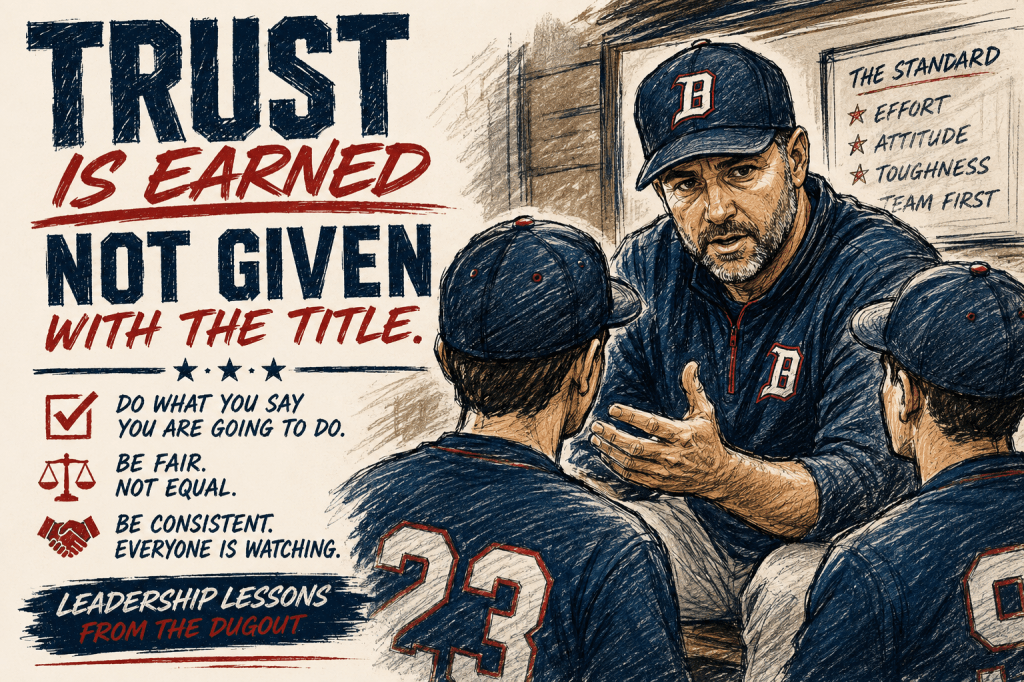
    Great leaders—whether on the baseball field or in the business world—needs a trusted voice. This is someone on your team who feels confident enough to tell you the truth, even when it’s not what you want to hear.. In sports, that trusted voice can be the difference between making the right call and missing something important. In business, it can be the key to unlocking better team performance and avoiding costly missteps.

    In baseball, that voice helps you uncover what’s happening off the field.. Is a player struggling off the field? Is someone being mistreated or bullied? Are the drills you’re running actually producing results? The answers to these questions don’t always come from formal evaluations or surface-level conversations—they often come from the people who know the team intimately and are paying close attention. I experienced this firsthand during a 16u travel game. One of our players had taken a ball to the head before the game, but I didn’t catch the signs of a concussion right away. In the dugout, a player I trusted came to me and said, “You have to get him out of the game—something’s not right.” Because of the trust we had built, he felt empowered to speak up. That moment potentially prevented a much more serious situation. Without that voice, the outcome could have been harmful for both the player and the team. The workplace is no different. Leaders often operate at a high level, making it easy to miss the day-to-day details that impact performance. If you’ve earned the trust of a team member, they may step in and share a critical insight—perhaps about a struggling employee, a broken process, or a looming conflict. These moments only happen when someone feels safe enough to speak honestly and knows they will value their input. Creating this kind of trust doesn’t happen overnight. It requires leaders to listen with openness, respond without judgment, and demonstrate that feedback—is taken seriously without consequence.. It also means setting a tone where truth is the most important thing. Whether you’re leading a team on the field or in the office, find that trusted voice. Nurture it. Listen to it. Because in the moments that matter most, it’s often that one voice that can help you make the right decision for the people you’re responsible for.